
St. Thomas Aquinas
Thomas Aquinas is the greatest theologian of the Catholic Church, whose Summa Theologica synthesized faith and reason. His fellow students called him the "Dumb Ox" but his teacher predicted his bellowing would fill the world.
- Feast day
- Jan 28
- Known as
- Doctor · Religious
- Era
- medieval
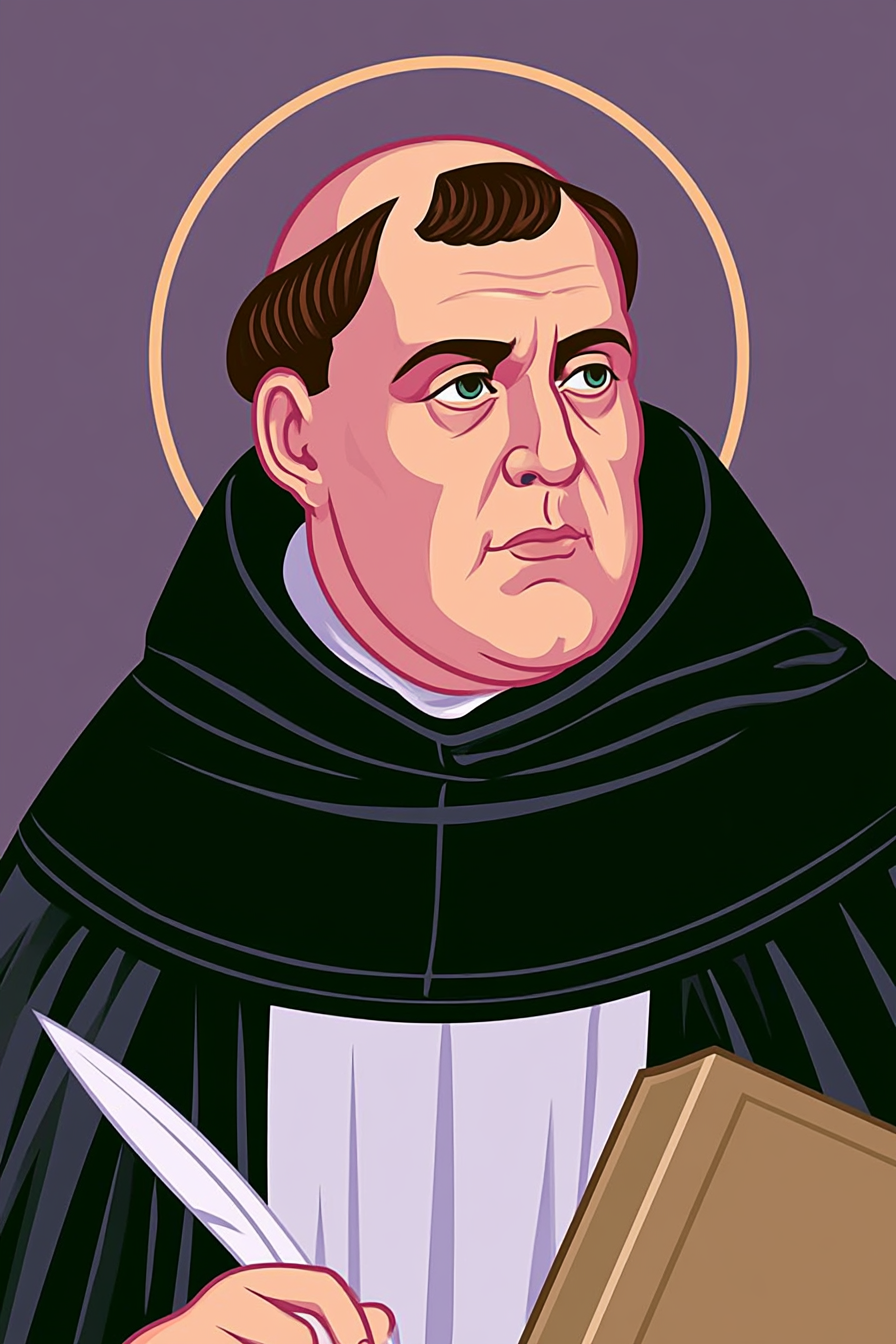
Who they were
Thomas Aquinas was born in 1225 in the castle of Roccasecca, Italy, into a noble family. His early education took place at the Benedictine monastery of Monte Cassino, where he began to develop a strong foundation in philosophy and theology. At the age of five, he was sent to the University of Naples, a vibrant center of scholarly activity. It was there that he was introduced to the writings of Aristotle, which would profoundly influence his own thought.
In his late teens, Thomas felt a calling to the religious life and decided to join the Order of Preachers, known as the Dominicans. His family, however, opposed his decision, wanting him to pursue a secular career as a nobleman. To prevent him from joining the Dominicans, his family imprisoned him for a year. Despite this, Thomas remained steadfast in his resolve, and eventually, he escaped and joined his fellow brothers.
Thomas’s time as a Dominican in Paris allowed him to study under the prestigious scholars of the time, including Albertus Magnus. He quickly earned a reputation for his intellect and depth of understanding, but his quiet demeanor and size led his peers to nickname him the "Dumb Ox." Albertus Magnus famously foresaw that this "ox" would bellow in a way that would echo throughout the world, a prophecy that would soon be fulfilled.
His major work, the "Summa Theologica," began around 1265 and represents a comprehensive synthesis of Christian theology and Aristotelian philosophy. This monumental text systematically explores the existence of God, the nature of humanity, and the moral life, providing answers to the most pressing theological questions of his day. The "Summa" remains foundational in Catholic education and is celebrated for its rigorous logic and coherence.
In addition to the "Summa Theologica," Thomas authored numerous writings, including the "Summa contra Gentiles" and several commentaries on Scripture. His work provided theological insights that bridged faith and reason, emphasizing that both could coexist harmoniously. He argued that human reason, when properly used, leads one closer to divine truths.
Throughout his life, Thomas lived a life of deep prayer and humility, consistently relying on the grace of God. He faced criticism from various factions, particularly those who opposed the integration of philosophy with theological doctrines. Nevertheless, he remained committed to his beliefs, engaging in debates and defending the Church's teachings against heretical views.
Thomas Aquinas passed away on March 7, 1274, while traveling to the Second Council of Lyons. His last words highlighted his deep love for the Eucharist—he had a profound mysticism surrounding this sacrament. Despite his physical absence, his legacy continues to influence countless theologians, philosophers, and laypeople.
In 1323, he was canonized by Pope John XXII, and in 1567, he was declared a Doctor of the Church. His feast day is celebrated on January 28, reminding the faithful of his immense contribution to Catholic thought. St. Thomas Aquinas is often referred to as the "Angelical Doctor" for his insight and the clarity he brought to theological matters, residing as the Church's greatest intellectual light in a turbulent medieval world. His teachings remain a cornerstone of Catholic education and continue to inspire generations seeking a deeper understanding of faith and reason.
Remembered for
Thomas Aquinas is celebrated as one of the most influential theologians in the Catholic tradition, particularly for his monumental work, the Summa Theologica. In this text, he beautifully integrates faith and reason, establishing a framework that continues to guide Catholic thought today. His writings delve into the nature of God, morality, and the sacraments, emphasizing the harmony between divine revelation and human intellect.
Known for his intellectual rigor and clarity, Aquinas faced challenges due to his physical appearance and quiet demeanor, earning him the nickname "Dumb Ox." However, his profound insights and teachings have resonated through the ages. His feast day, celebrated on January 28, serves as a reminder of his contributions to the Church and the importance of seeking truth in both faith and reason.
Jan 28
How to recognize them
- BookRepresents his extensive theological writings and studies.
- Scallop ShellSymbol of pilgrimage in search of knowledge and truth.
- LilyStands for purity and enlightenment in faith and learning.
- OxSignifies his nickname, 'Dumb Ox,' reflecting his profound intelligence.
- StarDepicts the light of reason that shines through his teachings.
To one who has faith, no explanation is necessary. To one without faith, no explanation is possible.
St. Thomas AquinasPray with this saint
Holy Thomas Aquinas, guide us in the pursuit of truth and wisdom, illuminating our hearts and minds with your divine insights. Help us to integrate faith and reason in our lives, so we may serve God and others with love and understanding.
For your household
Integrating St. Thomas Aquinas into family life can be a rewarding experience for Catholic households. Start by observing his feast day on January 28 with a special family meal, perhaps focusing on dishes inspired by medieval Italy, where he lived. It’s a beautiful opportunity to discuss his life and works, igniting conversations about faith, reason, and morality with your children.
Encourage children to read age-appropriate excerpts from the Summa Theologica or stories about St. Thomas. You could create a family prayer corner where you place images or icons of St. Thomas and share a daily prayer asking for his intercession, particularly in matters of wisdom and discernment.
Consider celebrating name-days for any family members named after Thomas or another saint honored on the same day. This can include small gifts, blessings, or a special family activity, fostering a deeper appreciation for the saints living alongside us. In times of struggle or challenging decisions, gather as a family to invoke St. Thomas Aquinas to guide your paths, demonstrating reliance on both prayer and intellectual engagement with faith.
Pray as a household
Carry your family in prayer
Solua gives your family a simple, faithful rhythm of prayer — one unhurried moment at a time, for the people you carry by name.
Begin